Blackmail
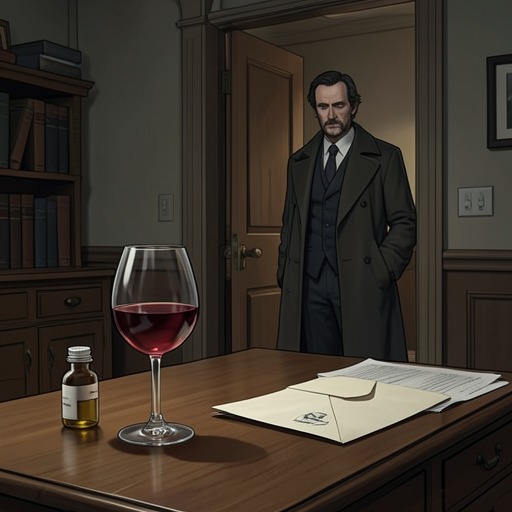
The Murder of Roger AckroydBlackmail in The Murder of Roger Ackroyd begins as a rumor and a clue, but resolves into the financial crime at the center of Dr. James Sheppard’s concealed past. It links the village’s appetite for gossip to the private transactions behind Mrs. Ferrars’s death and to Sheppard’s murder of Roger Ackroyd: information moves among witnesses, yet its full meaning remains hidden until Hercule Poirot joins the payments to the murderer’s motive.
The village rumor network
King's Abbot is described as a place where gossip is the principal recreation, sustained by a dense local network of people who observe, question, and report on one another. Caroline’s inability to discover much about the foreign newcomer at The Larches illustrates both the appetite for information and its limits: even the village’s ordinary suppliers have learned little about him. In this setting, a private word such as blackmail can quickly become a subject of conjecture, but circulation does not guarantee understanding.
The rumor acquires investigative weight when Dr. James Sheppard tells Inspector Davis that Parker could only have heard about blackmail by listening at the study door. Davis, however, has already questioned Parker about his behavior that evening. He says Parker appeared to know something and had offered a garbled account involving blackmail. Sheppard presents himself as ready to disclose what he knows, turning Davis’s inquiry about the butler into an opening for his own account. The exchange shows information being managed as carefully as it is gathered: a potentially damaging clue is framed as hearsay before its source and significance are settled.
The subject resurfaces as gossip in another social circle. Colonel Melrose tells Sheppard that he has heard the word blackmail mentioned in connection with Ackroyd’s mysterious death, then speculates that a woman must be involved. His confident guess is not an explanation of the crime; it is an example of how suspicion fills gaps before evidence can. The rumor is accurate in pointing toward blackmail, but incomplete about who committed it, who paid, and why the murder followed.
Parker’s overhearing and Poirot’s questions
Parker’s role clarifies how the rumor began. When Poirot asks whether he has experimented with blackmail, Parker reacts with alarm and denies the implication. Poirot tells him not to perform the part of an injured honest man and insists that he knows what Parker knows about the matter. Under further questioning, Parker admits that he tried to listen on the night of the murder. He says that he heard a word or two, and that Ackroyd’s wish not to be disturbed, together with his being shut in with the doctor, made him curious. Parker confirms that he heard the word blackmail, but his account establishes overhearing, not participation in the crime.
Poirot’s next question identifies the temptation that may have shaped Parker’s conduct: he suggests Parker wondered whether the information might be worth something to him. The distinction matters. Parker’s curiosity and his attempt to listen make him a carrier of partial information, but Poirot says he believes Parker lacks the nerve and courage required for blackmail. His task is to obtain the truth behind the word, not to mistake the person who overheard it for the person who used it.
The payments to Mrs. Ferrars
Hammond supplies the financial evidence. Looking back over the previous year, he recalls that Mrs. Ferrars sold certain securities and that the proceeds went into her account without being reinvested. Because she had a large income and lived quietly after her husband’s death, he had concluded that the money must have been spent for a particular purpose. When he once asked her about it, she explained that she had to support several of her late husband’s poor relations. Hammond accepted this account at the time.
His earlier assumption was that the money went to a woman who had a claim on Ashley Ferrars. He had not suspected that Mrs. Ferrars herself was involved in blackmail. Once Poirot asks for the actual sums, Hammond estimates that the payments made during the year amounted to at least twenty thousand pounds. The amount sharply changes the scale of the clue: what had seemed like unexplained withdrawals is shown to be a substantial, repeated transfer, disguised by a plausible explanation about family support.
The transaction also connects public inference to private records. Colonel Melrose’s speculation that a woman was involved is merely a guess, while Hammond’s account is grounded in the securities sold and the money credited to Mrs. Ferrars’s account. Yet even the financial evidence does not, by itself, identify the blackmailer. It establishes that the payments occurred and that Mrs. Ferrars’s explanation concealed their purpose; Poirot must connect those facts to a person with knowledge of the earlier death and a reason to keep Ackroyd from learning the truth.
Poirot’s explanation of the motive
At the final reckoning, Poirot names Dr. James Sheppard as the person who blackmailed Mrs. Ferrars. Sheppard’s medical position gave him a particular connection to Ashley Ferrars’s death: as the doctor who attended him, he was well placed to know what had killed him. Poirot explains that Sheppard had invented a legacy to account for Mrs. Ferrars’s twenty thousand pounds. The invented explanation had become necessary because the money had not come from an inheritance, but from the payments she made to him.
Poirot also sets out the financial and personal progression behind the crime. Sheppard lost most of the money through speculation, then pressed Mrs. Ferrars too hard. She found a way out that he had not anticipated by taking her own life. If Ackroyd discovered the truth, Poirot argues, Sheppard would have been ruined. Blackmail therefore provides the motive for silencing Ackroyd, while the payments and the fabricated legacy expose the weakness in Sheppard’s earlier account of his finances.
The final revelation changes the meaning of the earlier conversations. Sheppard’s readiness to tell Davis something, Parker’s overheard word, and Colonel Melrose’s guess all circle the same crime without naming its perpetrator. The contrast between rumor and proof is central: the village can repeat a true clue, and witnesses can hold parts of the truth, while the narrator’s own explanations conceal his involvement. Through Poirot’s reconstruction, blackmail is revealed not as an incidental scandal but as the link between Ashley Ferrars’s death, Mrs. Ferrars’s payments, Sheppard’s financial losses, and the murder of Roger Ackroyd.